
Marketing
Latest Study: SNS, Not Religion, Drives Indonesia's Cosplay Scene — Southeast Asia Insights from 260 Fans
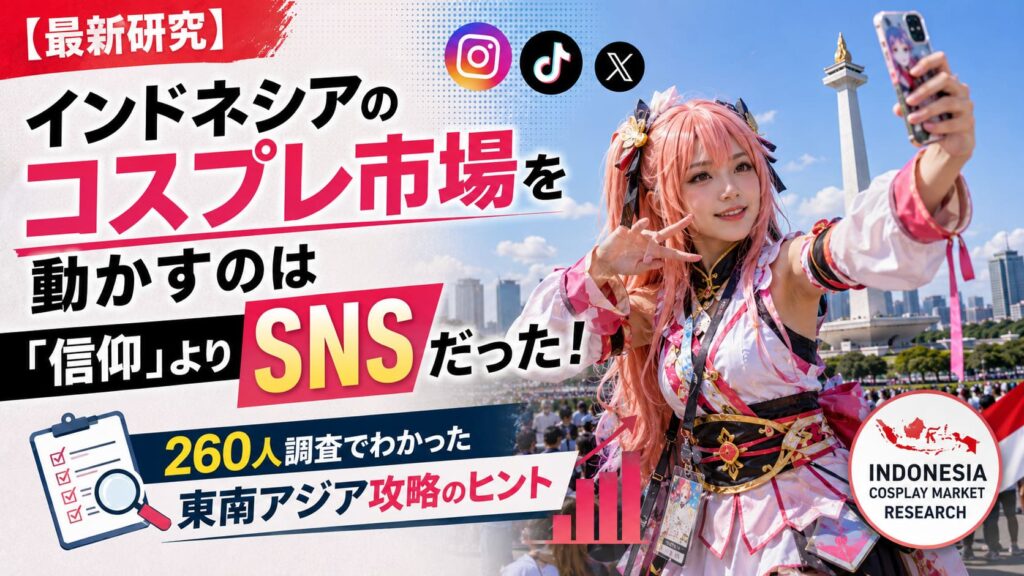
Indonesia has the world’s largest Muslim population. Did you know that anime and cosplay culture is actually spreading rapidly in this country right now?
At the same time, some of you may be wondering: “In a country with such strong religious devotion, doesn’t cosplay—with its often revealing costumes—clash with religion?” or “Isn’t religious values putting the brakes on cosplay merchandise purchases?”
An academic study (https://e-journals.dinamika.ac.id/jamb/article/view/1482/596) published in July 2026 tackled this very question head-on, using actual data. It surveyed 260 Indonesian cosplayers and statistically analyzed how three factors—”fanaticism,” “religiosity,” and “social media marketing”—influence purchasing behavior.
The conclusion? What was actually driving cosplay purchases in Indonesia wasn’t religiosity itself—it was social media. In this article, we’ll break down this research data and unpack the key points that creators and brands looking to engage in cosplay and anime-related activities in the Southeast Asian market should keep in mind.
| Reference paper: Saifuddin, M., & Khoirunnisa, T. A. (2026). Navigating Fanaticism, Religiosity, and the Impact of Social Media Marketing on Anime Cosplay in Indonesia. Journal of Applied Management and Business, 7(1), 86–102. Universitas Islam Negeri Sunan Ampel (Surabaya) / DOI: 10.37802/jamb.v7i1.1482 (CC BY 4.0)
※Source URL: https://e-journals.dinamika.ac.id/jamb/article/view/1482/596
So, what does Indonesia’s cosplay market actually look like?
First, as a premise: cosplay events have now grown worldwide into a multi-billion-dollar industry, with many sponsor companies taking notice of this passionate fan community.
What makes Indonesia unique is that Islam is deeply woven into daily life for much of the population. As the researchers point out, cosplay can sometimes clash with religious and social norms—for example, friction actually exists around issues like “revealing costumes going against standards of decent dress in Indonesia.”
In other words, Indonesia’s cosplay culture is being cultivated within a unique environment where two sometimes-conflicting forces—”passion for anime” and “religious values”—are constantly pulling against each other. It’s precisely this complexity that the study set out to examine.
Inside the survey: Who exactly are these 260 cosplayers?
For this study, researchers conducted a survey of 260 people from cosplayer communities across Indonesia. Responses were gathered through a combination of online surveys via WhatsApp, Telegram, and Instagram, along with paper questionnaires. The analysis used a statistical method known as PLS-SEM.
Looking at the profile of respondents gives us a snapshot of the current state of Indonesia’s cosplay scene.
- Gender: Women make up the majority at 63%, versus 37% men
- Age: Those aged 15–24 account for over 80% of the total, with late teens to early twenties forming the core demographic
- Occupation: Students overwhelmingly lead at 69%, followed by self-employed individuals at 16%, and company employees/civil servants at 12%
- Purchase frequency: 1–2 times: 46%, 3 times: 30%, more than 3 times: 24%
- Purchase channel: An astonishing 83% purchase their anime costumes via social media
That last number deserves special attention. The fact that over 80% of people are buying cosplay costumes through social media platforms already tells us that SNS has become the main battleground for purchasing.
[Result 1] The Strongest Purchase Engine Is “Fanaticism”
As a result of the analysis, what most strongly pushed up purchasing behavior was fanatical love (fanaticism) for characters and works. A very strong statistical influence (path coefficient 0.521) was confirmed as well.
Why? The researchers explain this using “social identity theory.” For devoted fans, a cosplay costume isn’t just a product—it’s a symbol showing “I am a member of this community,” a marker of belonging. That’s exactly why the feeling of “I love this” outweighs economic cost-benefit thinking, loosening the purse strings.
What’s even more interesting is that fanatical fans also had a strong influence on SNS marketing (path coefficient 0.549). In other words, they aren’t merely passive recipients of corporate marketing. They function as “voluntary marketers” who create, share, and spread cosplay-related content themselves. Through word-of-mouth and user-generated content (UGC), we can see a structure where fans themselves are the ones driving market excitement.
[Result 2] Surprising! “Religiosity” Does Not Directly Drive Purchases
This is the most surprising discovery of this study.
Religiosity had no direct effect on cosplay purchasing behavior (not statistically significant, and if anything, slightly negative). Given that this is the world’s largest Muslim-majority country, this may seem like a surprising result.
The researchers interpret it this way: for many Indonesian cosplayers, cosplay is not seen as a “religious act,” but rather as part of their hobbies, leisure, and self-expression. It’s not something that “conflicts with” religious beliefs—it’s simply enjoyed as an activity belonging to an entirely separate category.
It’s also analyzed that a major factor was the fact that most respondents were young, aged 15–24. This age group tends to place greater importance on “the pursuit of self-identity” and “approval from peers” than on religious norms. This is considered to be why religiosity did not directly hinder cosplay purchasing.
[Result 3] Religiosity Takes Effect “Through Social Media”
So does this mean religiosity is completely irrelevant? Not at all. This is the heart of the study.
According to the analysis, religiosity had a significant positive effect on SNS marketing (path coefficient 0.157). In other words, consumers with stronger religiosity react more sensitively to marketing messages on social media—but only when those messages are content that is **”trustworthy, respectful, and compatible with their own values.”**
And SNS marketing itself had a solid effect of boosting purchasing behavior (path coefficient 0.344).
Putting these together, a flow emerges like this:
Religiosity → SNS Marketing → Purchasing Behavior
Religiosity doesn’t move purchases “directly,” but when it passes through the channel of social media, it leads to purchasing. In statistical terms, this is called “full mediation.” Religious values on their own don’t become a motivation for cosplay purchases, but when translated into careful, community-oriented, and trustworthy SNS communication, they indirectly encourage purchasing.
Fanaticism, on the other hand, showed “partial mediation.” Fanaticism directly encourages purchasing while also further boosting purchases via social media—a dual function.
Incidentally, this model produces quite compelling results, explaining 51.5% of SNS marketing and 59% of purchasing behavior.
So What Should You Do to Operate in the Southeast Asian Market?
Let’s translate the results so far into “actionable lessons” from the perspective of cosplayers, influencers, and related brands. We’ll organize this while also incorporating the practical recommendations raised by the researchers.
1. A “Fun Community” Is the Strongest Promotional Tool
Fanatical fans are people who will create and spread content on their own, even if left alone. That’s precisely why, rather than one-off advertisements, building a comfortable community where fans can spend a long time together is effective. Providing online spaces for interaction, encouraging user posts, and partnering with influencers within the community—this kind of steady relationship-building ultimately leads to sales.
2. Think of SNS as the main battlefield
Given that 83% of respondents purchase via SNS, social media isn’t just a “bonus promotional channel” but the central stage for purchasing. Product information dissemination, peer-to-peer recommendations, and community interaction all happen on SNS, and this reduces purchase anxiety and pushes people toward buying.
3. See religion not as a “wall” but as something to “harmonize with”
This might be the biggest takeaway. It would be hasty to dismiss devout consumers as “customers uninterested in cosplay.” If you deliver culturally and religiously respectful, considerate content, they too can respond via SNS and become a purchasing segment. The researchers conclude that “rather than viewing religiosity as a barrier, appropriately designed SNS communication can harmonize faith identity with fan identity.”
4. “Trust” and “respect” are the keywords
Devout consumers are more receptive to messaging that is trustworthy, respectful, and compatible with their values, rather than pushy advertising. Sincerity over flashiness—that’s what works in Southeast Asia’s Islamic markets.
Summary: The path to conquering the Indonesian market comes down to “SNS”
The reality of the Indonesian cosplay market revealed by this research can be summarized in these three points.
- Passion for the work and characters is the strongest driver of purchases. Costumes are a symbol of identity showing “I love this,” and passionate fans also become spontaneous promoters.
- Religiosity itself does not directly drive purchases. For the younger generation, cosplay is enjoyed as a “hobby” in a category separate from religion.
- Religiosity only connects to purchasing through SNS. Religiously considerate SNS communication bridges faith identity and fan spirit.
Even in a market that seems daunting at first glance—the world’s largest Muslim-majority country—the key ultimately lies in “a passionate community” and “respectful SNS communication.” Whether these two elements can be carefully nurtured seems to determine success or failure in the Southeast Asian market.
The anime and cosplay markets of Southeast Asia, starting with Indonesia, should only get more interesting from here. We’ll keep tracking these developments, looking at both the numbers and the passion of the fans.
This article is based on an academic paper (CC BY 4.0 license) published in the Journal of Applied Management and Business, reorganized in an easy-to-understand way by the OTABASE editorial team. The figures and survey results are based on the original paper.
※Source URL: https://e-journals.dinamika.ac.id/jamb/article/view/1482/596